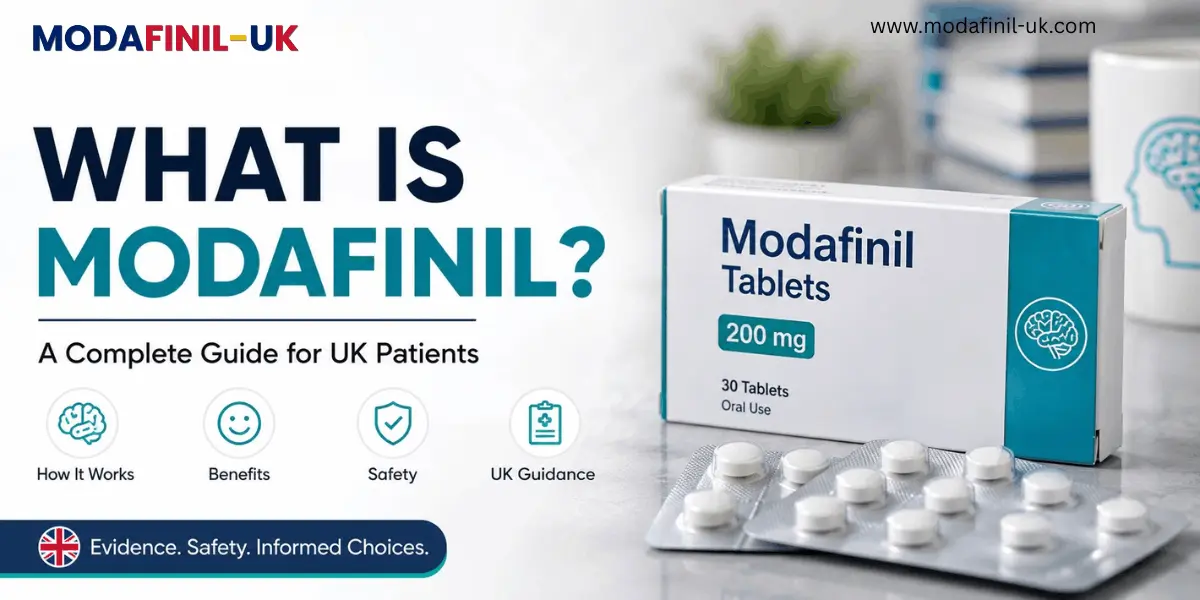
What is modafinil?
Modafinil is a wakefulness-promoting medicine. It belongs to a group of medicines sometimes described as eugeroics, a term referring to medicines that promote alertness and wakefulness.
Unlike ordinary products used to fight tiredness, modafinil uk is intended for specific medical conditions involving excessive sleepiness.
In the UK, modafinil is available as a generic prescription medicine. Current UK product information states that it is indicated for adults with excessive sleepiness associated with narcolepsy, whether or not cataplexy is present. The medicine does not cure narcolepsy. Instead, its purpose is to help a person remain awake and functional during the daytime.
This distinction is important. Someone who is simply tired after a poor night's sleep is not automatically a candidate for modafinil. Excessive daytime sleepiness can have many possible causes, and a proper medical assessment is needed before a wakefulness-promoting medicine is considered.
What does modafinil do?
The simplest way to explain modafinil is that it helps the brain maintain wakefulness.
People with narcolepsy can experience overwhelming daytime sleepiness and an increased tendency to fall asleep at inappropriate times. NHS guidance explains that medicines such as modafinil can help keep people awake during the day. The aim is therefore not to create artificial energy or allow someone to function indefinitely without sleep. Instead, buy modafinil uk can reduce the tendency towards excessive daytime sleepiness.
For a person whose sleep-wake regulation is affected by narcolepsy, that difference can be significant. Better control of daytime sleepiness may make ordinary activities, work, education and social life easier to manage. However, individual responses vary. Some people find modafinil helpful, while others may experience side effects or insufficient improvement and need a different treatment approach.
How does modafinil work?
One of the most common questions is “how does modafinil uk work?”
The complete mechanism is complicated and has not been fully established. UK product information describes modafinil as a wakefulness-promoting agent, but its effects involve several neurotransmitter systems rather than one simple pathway. Research indicates that modafinil affects dopamine signalling and also influences other systems involved in maintaining alertness. One important action involves the dopamine transporter. By affecting dopamine reuptake, modafinil can increase dopamine signalling in parts of the brain.
Modafinil also interacts indirectly with systems involving:
- Dopamine
- Noradrenaline
- Histamine
- Orexin
- Glutamate
- GABA
These systems are involved in alertness, attention, arousal and sleep-wake regulation. The result is a medicine that promotes wakefulness without being identical to traditional stimulant medicines. The mechanism is explored in more detail in our dedicated guide to how modafinil works, where we look more closely at the brain pathways involved.
Does modafinil give you energy?
Not exactly.
This is one of the most important misconceptions about the medicine. Modafinil does not provide calories, replace sleep or physically recharge the body. Its primary effect is on wakefulness and alertness. Imagine that excessive sleepiness is making it difficult for someone to remain awake long enough to work, study or perform normal daily activities. Modafinil may reduce that sleepiness.
That is different from making a healthy, well-rested person dramatically more energetic.
For patients with narcolepsy, the practical benefit may be substantial because reducing excessive sleepiness can make concentration and normal daytime functioning easier. But modafinil should not be viewed as a replacement for adequate sleep.
What is narcolepsy?
To understand why modafinil is prescribed, it helps to understand narcolepsy.
Narcolepsy is a long-term neurological sleep disorder that affects the normal regulation of sleep and wakefulness.
One of its main symptoms is excessive daytime sleepiness. A person may feel an overwhelming need to sleep during the day or may fall asleep unintentionally.
Other symptoms can include:
- Cataplexy
- Sleep paralysis
- Vivid experiences when falling asleep or waking
- Disrupted night-time sleep
- Abnormal sleep patterns
Cataplexy is particularly associated with type 1 narcolepsy. It involves a sudden temporary loss of muscle control, often triggered by strong emotions such as laughter or surprise.
Narcolepsy is therefore very different from ordinary tiredness.
The condition can interfere with employment, education, relationships and everyday activities. NHS guidance notes that treatment can help reduce the impact of narcolepsy on daily life.
Why is modafinil used for narcolepsy?
The main problem modafinil addresses is excessive daytime sleepiness.
A person with narcolepsy may have difficulty maintaining wakefulness even when they have tried to establish a regular sleep routine. Modafinil can help promote wakefulness during the day, making it easier for some patients to remain alert. It is important to understand that modafinil does not necessarily treat every symptom of narcolepsy.
For example, it is primarily aimed at excessive daytime sleepiness rather than directly treating cataplexy.
Narcolepsy treatment may therefore involve a combination of medication, planned naps, consistent sleep habits and other approaches depending on the person's symptoms. The NHS recommends practical measures such as regular short naps and maintaining a consistent bedtime and wake-up routine alongside medical treatment where appropriate.
Is modafinil licensed in the UK?
Yes, but its UK licence is narrower than many people realise.
Current UK medicine information states that modafinil is indicated for:
Adults with excessive sleepiness associated with narcolepsy, with or without cataplexy.This is why it is important to distinguish between licensed use and off-label prescribing.A medicine can sometimes be prescribed outside its licensed indication when a clinician considers that appropriate. However, this does not mean that every condition associated with tiredness is an accepted indication for modafinil.UK NHS formularies can also differ in how they manage off-label prescribing and specialist initiation. For example, some local formularies allow specialist use for particular conditions, while others restrict modafinil to narcolepsy.
For patients, the key point is simple: the reason for prescribing should be discussed with the treating clinician rather than assumed from information found online.
Is modafinil a stimulant?
Modafinil is often described as a stimulant because it increases alertness, but it is more accurately described as a wakefulness-promoting medicine.
It has a different pharmacological profile from traditional stimulant medicines such as amphetamine-based treatments. That does not mean it is risk-free. Modafinil can cause adverse effects, and UK prescribing information includes warnings concerning psychiatric symptoms, cardiovascular effects and serious skin reactions.
For this reason, it should be treated as a genuine prescription medicine rather than a harmless productivity supplement.
What does modafinil look like?
UK modafinil is supplied as oral tablets.
Generic products are available in 100 mg and 200 mg strengths, according to UK prescribing information. The exact appearance of a tablet can vary between manufacturers, so patients should identify their medicine using the packaging and patient information leaflet rather than relying only on colour or shape. The strength prescribed is a clinical decision. Patients should not change the amount they take simply because a different strength is available or because they have read about another person's dose online.
For detailed information about standard UK dosing, see our dedicated article on modafinil dosage.
What happens after taking modafinil?
Modafinil is taken orally and is generally used during the daytime because its wakefulness-promoting effects can last for many hours. The medicine is absorbed into the bloodstream and reaches the brain, where it affects systems involved in alertness and wakefulness. Patients may notice that they feel more able to stay awake or that daytime sleepiness is less intrusive. That does not necessarily mean the medicine will produce a dramatic sensation. In fact, an effective treatment may simply make ordinary daytime activities feel more manageable. The goal is better control of excessive sleepiness, rather than a feeling of being unusually stimulated.
Can modafinil replace sleep?
No.
This is perhaps the most important misconception to correct. Modafinil can promote wakefulness, but it does not remove the biological need for sleep. Using a wakefulness-promoting medicine to repeatedly compensate for insufficient sleep is not the same as treating a diagnosed sleep disorder. If someone is regularly sleeping too little because of work, studying, shift patterns or lifestyle, the appropriate solution is to address the underlying sleep problem.
The NHS recommends healthy sleep routines as part of managing narcolepsy and notes that planned short naps can be useful for people experiencing excessive daytime sleepiness.
Is modafinil a “smart drug”?
Modafinil has developed a reputation as a smart drug or cognitive enhancer.
That reputation largely comes from research and media coverage involving healthy people who use the medicine without a medical indication.Some studies have reported effects on attention or certain aspects of cognitive performance, particularly under conditions of sleep deprivation. However, that does not mean modafinil is an approved general-purpose cognitive enhancer.
For UK patients, this distinction matters.
A prescription medicine approved for narcolepsy should not automatically be considered appropriate for studying, working longer hours or improving productivity. There is also an important difference between feeling more awake and demonstrating a clinically meaningful improvement in overall cognitive performance. If you want to understand the evidence behind modafinil and cognition, that topic is better covered separately rather than mixed into a basic explanation of what the medicine is.
Is modafinil available through the NHS?
Modafinil can be prescribed within NHS care when clinically appropriate.
For narcolepsy, treatment generally follows assessment and diagnosis by clinicians experienced in sleep disorders. The UK product information states that treatment should be initiated by, or under the supervision of, a physician with appropriate knowledge of the relevant disorders. The exact prescribing pathway can vary between NHS services and local formularies. A GP may recognise symptoms and arrange referral to an appropriate specialist or sleep service. Once a diagnosis has been established, treatment options can be discussed.
This is different from purchasing modafinil online without a prescription.
Can you buy modafinil without a prescription in the UK?
Modafinil is a Prescription Only Medicine (POM) in the UK.
That means legitimate treatment requires a prescription from an appropriately qualified prescriber.
Websites offering prescription medicines without appropriate clinical oversight can create additional risks. The problem is not simply whether a tablet contains modafinil. Patients also need appropriate diagnosis, assessment of contraindications, review of other medicines and monitoring where required.
A genuine medicine should come through a regulated supply chain. If you are considering modafinil because you experience persistent daytime sleepiness, discussing the symptom with a GP or appropriate healthcare professional is safer than self-diagnosing.
Is modafinil safe?
There is no simple yes-or-no answer.
Modafinil has an established medical role, but like other prescription medicines it has potential risks and is not suitable for everyone. UK product information lists contraindications including uncontrolled moderate-to-severe hypertension, cardiac arrhythmias and hypersensitivity to the medicine or its ingredients. It also contains important warnings about serious skin reactions and psychiatric effects.
Pregnancy is another particularly important issue. The MHRA advises that modafinil should not be used during pregnancy because available evidence suggests an increased risk of congenital malformations. Effective contraception is advised during treatment and for two months after stopping. Modafinil can also reduce the effectiveness of some hormonal contraceptives.
For a complete discussion, read our dedicated guides on modafinil side effects, modafinil safety, modafinil interactions, and modafinil and contraception.
Who might be considered for modafinil?
The clearest UK indication is an adult with a confirmed diagnosis of narcolepsy who experiences excessive daytime sleepiness.
However, suitability is individual.
A clinician may consider:
- The underlying diagnosis
- Severity of daytime sleepiness
- Other medical conditions
- Current medicines
- Cardiovascular health
- Psychiatric history
- Pregnancy or contraception considerations
- Previous response to treatment
- Potential side effects
The purpose of this assessment is to make sure the medicine is appropriate for the individual rather than simply matching a symptom with a drug.
What should you remember about modafinil?
If you only remember a few points from this guide, remember these:
- Modafinil is a prescription wakefulness-promoting medicine.
- Its main UK licensed use is excessive daytime sleepiness associated with narcolepsy in adults.
- It works through several brain signalling systems and its complete mechanism is not fully understood.
- It does not replace normal sleep or cure narcolepsy.
- It is not simply a general treatment for tiredness or a licensed “smart drug”.
- It can have important side effects, contraindications and interactions.
- It should be used under appropriate medical supervision.
Medical disclaimer
This article is for general educational information and does not replace individual medical advice. Modafinil is a prescription-only medicine in the UK. If you have persistent excessive daytime sleepiness, speak with your GP or an appropriate healthcare professional rather than starting treatment without medical assessment. Always follow the instructions supplied with your prescribed medicine and discuss concerns with your doctor or pharmacist.

Comments........!